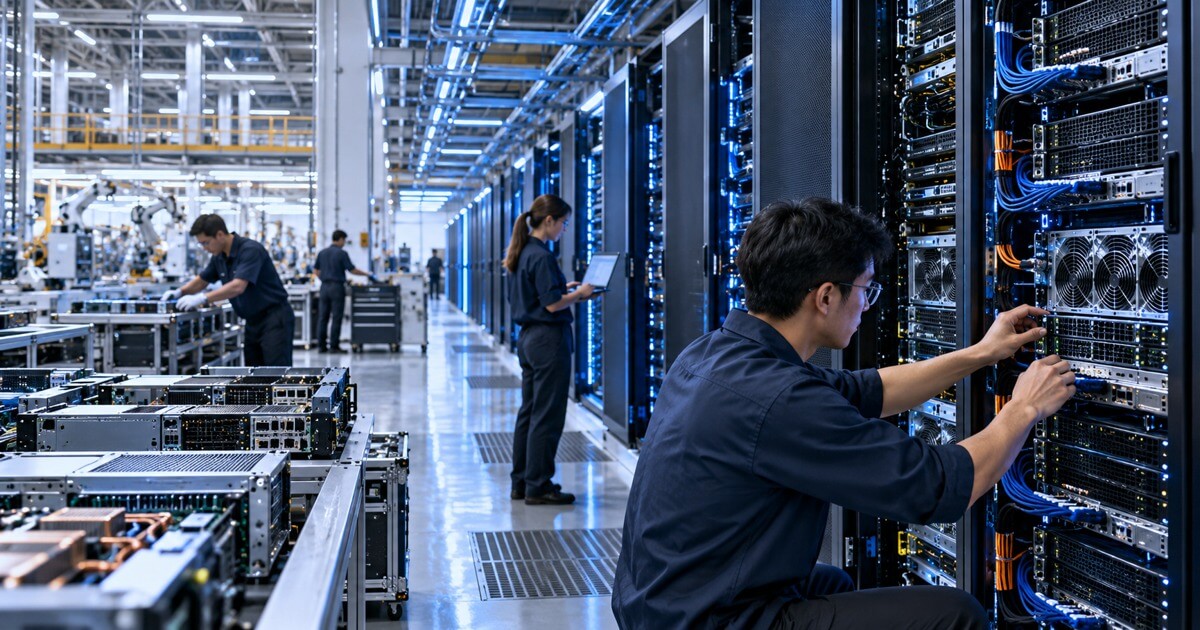
Foxconn OpenAI collaboration is moving into a new phase as the world’s largest contract electronics manufacturer prepares another artificial intelligence hardware tie-up with the ChatGPT maker. The development matters because the AI boom is no longer only about software models. It increasingly depends on servers, racks, networking, power systems, cooling and large-scale manufacturing.
Foxconn Chairman Young Liu said on October 30 that he had met OpenAI CEO Sam Altman and that another announcement would come once details were finalised. He did not disclose financial terms, production volumes or a launch timeline.
That means the new Foxconn OpenAI arrangement should still be treated as a developing collaboration rather than a completed deal. Even so, it reinforces how important physical infrastructure has become to the economics of advanced AI.
Foxconn OpenAI Collaboration Builds on Existing AI Hardware Work
Foxconn and OpenAI already have a formal relationship. In 2025, the companies announced plans to co-design and engineer multiple generations of AI data-centre racks and related components in the United States.
The earlier initiative also covered cabling, networking, cooling and power systems. A new Foxconn OpenAI collaboration would therefore expand a relationship already connecting OpenAI’s infrastructure requirements with Foxconn’s engineering and manufacturing scale.
For OpenAI, this matters because advanced models require increasingly large amounts of computing capacity. The systems around AI chips must be designed, assembled, cooled, powered and connected efficiently. Foxconn sits directly inside that physical layer.
AI Servers Are Becoming Central to Foxconn’s Growth
Foxconn is still widely associated with consumer electronics manufacturing, but its business mix is changing.
The company is Nvidia’s largest AI server manufacturer, and its cloud and networking products segment has become a major contributor to revenue. Foxconn said the segment, which includes AI servers, accounted for 51% of second-quarter revenue, crossing the halfway mark for the first time.
Liu also said Foxconn has six factory buildings in Houston producing AI servers for Nvidia and sees room for further expansion.
This shift helps explain why the Foxconn OpenAI relationship deserves attention. AI infrastructure gives the manufacturer exposure to one of the fastest-growing parts of the technology industry at a time when demand for traditional electronics can be more cyclical.
Foxconn also expects double-digit growth next year, according to Reuters.
Foxconn OpenAI Push Comes During an AI Spending Debate
The timing is important. Investors are becoming more cautious about the enormous amount of money being committed to AI infrastructure.
Technology companies are spending heavily on data centres, accelerators, networking equipment and electricity capacity. The central question is no longer whether AI demand exists. It is whether the returns from that spending will arrive quickly enough to justify the scale of investment.
Liu rejected the idea that artificial intelligence is in a bubble. His confidence reflects Foxconn’s position as a supplier to companies that continue to expand AI infrastructure.
That tension makes manufacturers such as Foxconn particularly interesting. Unlike model developers, they can benefit directly from the infrastructure build-out as hyperscalers and AI companies keep expanding capacity.
Why Foxconn OpenAI Matters for India
There is no confirmation that the new collaboration will involve Foxconn’s Indian factories, and it would be wrong to assume that it will.
The India relevance is nevertheless significant.
Foxconn has expanded its manufacturing footprint in India as global electronics supply chains diversify. India, meanwhile, is trying to move beyond smartphone assembly toward higher-value electronics, semiconductors, data centres and advanced computing infrastructure.
Breakington has already examined how India’s mobile production-linked incentive programme helped expand smartphone manufacturing and exports. AI servers are a more technically demanding category, but the broader industrial logic is similar.
If AI hardware becomes a durable global manufacturing segment, countries that can support advanced electronics production will compete for a larger share of that supply chain.
That could include server components, power systems, cooling equipment and specialised assembly.
AI Infrastructure Is Becoming a Separate Technology Industry
The biggest lesson from the Foxconn OpenAI story is that the AI economy is separating into multiple layers.
Model companies develop the software. Chipmakers supply accelerators. Cloud providers build computing capacity. Networking companies try to remove data bottlenecks. Manufacturers assemble the complex systems that connect everything together.
Breakington’s recent coverage of Marvell and Lumentum highlighted the same trend from another angle: AI performance increasingly depends on how efficiently enormous amounts of data can move between processors and data centres.
Foxconn sits at the manufacturing end of that chain.
The next OpenAI announcement will matter because it could show how far the relationship is moving beyond its existing infrastructure cooperation. Until details are released, expectations should remain measured.
But the direction is already clear. The Foxconn OpenAI partnership reflects a larger shift in artificial intelligence from a software-only story toward a global industrial build-out. The companies that can manufacture, connect, power and cool AI systems may become just as important to the next stage of the industry as the companies developing the models themselves.
Sources: Reuters; OpenAI’s existing Foxconn collaboration announcement.