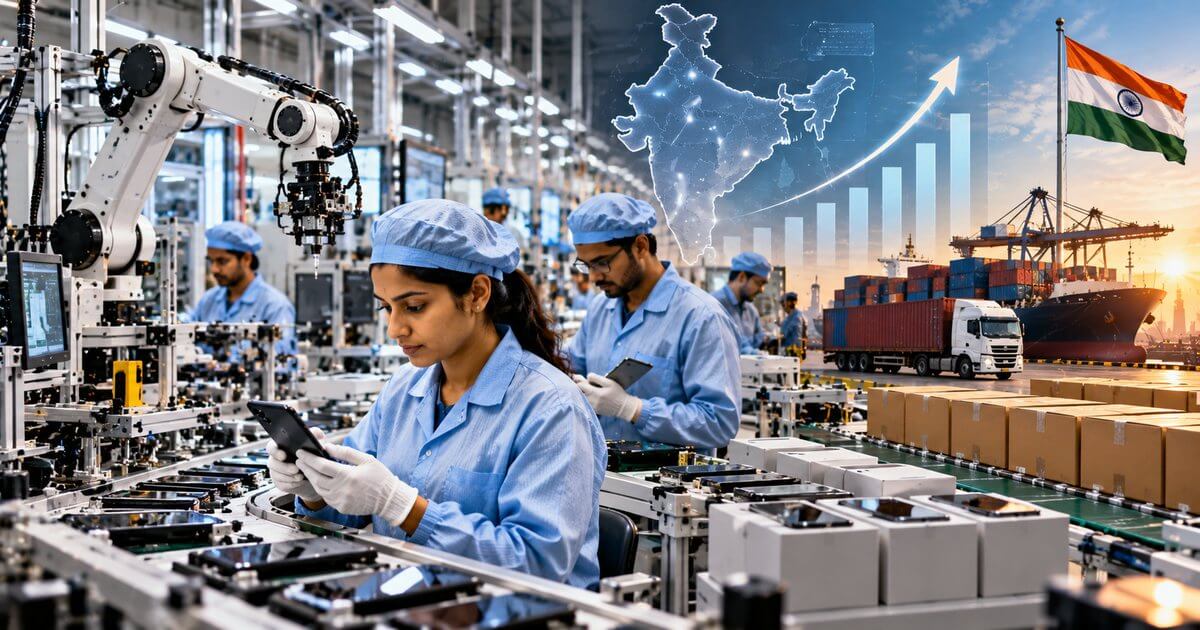
India mobile PLI has become one of the clearest tests of whether manufacturing subsidies can create a wider economic return. The government says it paid about ₹19,000 crore in incentives under the mobile phone production-linked incentive scheme, while the smartphone sector generated roughly ₹3.25 lakh crore in taxes over five years through FY2025-26.
Electronics and IT Minister Ashwini Vaishnaw said the figure included around ₹25,000 crore in direct taxes and roughly ₹3 lakh crore in GST, according to Financial Express. Some syndicated reports carried a much lower ₹3,000 crore GST figure, which does not reconcile with the stated ₹3.25 lakh crore total. For that reason, the larger GST figure should still be read as a ministerial claim rather than an independently audited industry total.
Even with that caveat, the broader manufacturing numbers show how dramatically India’s mobile phone industry has changed.
India mobile PLI helped turn phones into a major export
Official government data shows mobile phone exports rising from about ₹1,500 crore in FY2014-15 to ₹2.59 lakh crore in FY2025-26. Production increased from roughly ₹18,000 crore to ₹6.27 lakh crore over the same period.
Smartphones also became India’s largest individual export product in FY2025-26. The government says India is now the world’s second-largest mobile phone manufacturer by volume and that 99.2% of phones used domestically are made in the country.
That is a major shift from a decade ago, when India depended far more heavily on imported finished phones.
The jobs argument is just as important as the tax argument
The government estimates that electronics manufacturing now supports around 25 lakh jobs, with mobile manufacturing alone accounting for about 12 lakh. Official data also says women make up nearly 70% of the workforce in several high-precision mobile manufacturing segments.
That matters because the political case for PLI was never only about exports. It was also about creating large-scale manufacturing employment and drawing global supply chains into India.
On that measure, the India mobile PLI story looks materially different from a simple subsidy programme. It has helped anchor large assembly operations and encouraged suppliers to expand around them.
But exports do not tell the whole story
The strongest criticism of India’s electronics push is that high export numbers can hide continued dependence on imported components.
India still imports substantial quantities of displays, semiconductors, camera modules, batteries and other components used inside smartphones. Financial Express noted that electronics and component imports have also grown sharply, which means gross exports are not the same as net value created domestically.
Government data has previously placed domestic value addition in mobile manufacturing at around 23% in FY2023-24. That number has improved over time, but it also shows why the next phase is more difficult than the first.
The next India mobile PLI phase is about deeper localisation
The original large-scale electronics PLI ended on March 31, 2026. In July, the Union Cabinet approved a new ₹62,500 crore Mobile Phone Manufacturing Scheme running from FY2026-27 to FY2030-31.
The new framework shifts more attention toward domestic sourcing, design, research and development, and support for Indian brands. Incentives range from 2.25% to 5% of eligible sales, with additional support linked to local sourcing of key components and sub-assemblies.
That change reflects the real challenge ahead. India has already proved it can assemble phones at enormous scale. The harder task is capturing more of the value inside each device.
Why the ₹19,000 crore question matters
Industrial policy is often judged by the amount governments spend. The better question is what that spending creates in return.
In the case of India mobile PLI, the government can point to higher production, stronger exports, millions of jobs and substantial tax collections. Those are meaningful outcomes.
But the programme should not be judged only by headline export growth. The next test is whether India can reduce component dependence, raise domestic value addition, build stronger local brands and move further into design and intellectual property.
If that happens, the mobile manufacturing story will move from successful assembly expansion toward a deeper electronics ecosystem. That would be the more important long-term return on India’s PLI experiment.
Sources: Financial Express and official Press Information Bureau data on electronics manufacturing.