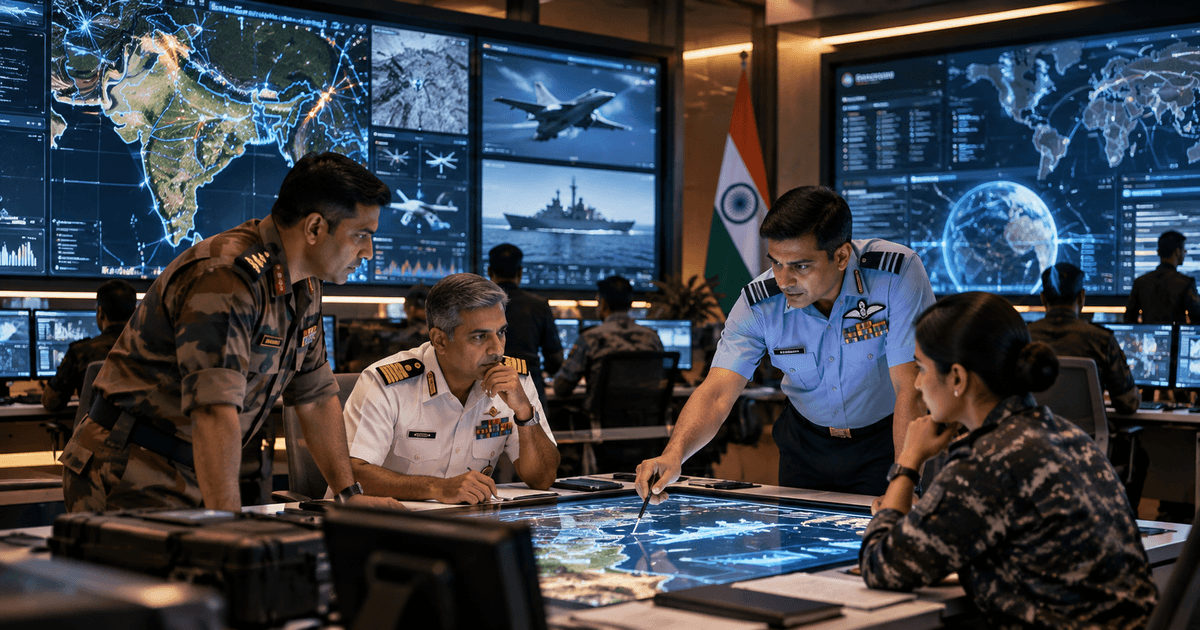
Sarvam Defence AI is set to become part of India’s military technology push after Bengaluru-based AI company Sarvam signed a five-year Memorandum of Understanding with Headquarters Integrated Defence Staff under the Ministry of Defence. The agreement will support AI projects for the Indian Army, Navy and Air Force.
The partnership creates a common framework for developing and deploying AI systems across the three services, along with joint and integrated organisations under HQ IDS. The focus will include military operations, training, knowledge systems and decision support.
Unlike a single product deal, this is designed as a broader technology partnership. The Sarvam Defence AI framework will support the technology layer, while HQ IDS helps coordinate projects across the armed forces.
Sarvam Defence AI could create a shared layer for the three services
One of the most important parts of the agreement is the idea of using common AI infrastructure across the Army, Navy and Air Force.
Sarvam says the services will be able to use the same foundation models, agentic infrastructure, geospatial systems and perception tools. This could allow lessons learned from one service to be reused by another instead of every branch building its AI systems separately.
That matters because modern military operations increasingly depend on large volumes of data from sensors, satellites, surveillance platforms and other systems. Turning that information into useful decisions quickly is becoming a major part of defence technology.
The Sarvam Defence AI partnership is expected to work on areas such as decision support, target acquisition and data fusion across what the company describes as the “sensor-to-shooter loop.”
Human oversight will remain part of operational decisions
The use of AI in defence naturally raises questions about how much decision-making should be handed to software.
According to Sarvam, human oversight will remain part of operational decisions. The company has positioned the technology as a layer that helps military personnel process information and make decisions rather than replacing human command.
HQ Integrated Defence Staff also described the partnership as a move toward building secure, sovereign and scalable AI capabilities for India’s defence forces, with emphasis on data sovereignty and responsible AI.
That distinction is important. Defence systems may handle highly sensitive information, making control over data, infrastructure and model deployment particularly important.
Why sovereign AI matters for India’s military
The term “sovereign AI” has become increasingly important in India’s technology policy.
In simple terms, it means building critical AI systems with greater domestic control over the models, computing infrastructure and data involved. For defence, relying entirely on foreign AI platforms could create concerns around security, availability and long-term strategic dependence.
Sarvam says the AI layer developed under the agreement will be built in India and deployed on sovereign infrastructure. That makes Sarvam Defence AI relevant not only as a technology project, but also as part of India’s wider push for strategic control over critical digital systems.
The work will be handled through Chanakya, Sarvam’s firewalled national security and defence division. The unit will use the company’s broader AI technology stack, including its Sarvam 105B foundation model.
This also fits into the government’s wider push for Atmanirbharta, or self-reliance, in defence technology.
Sarvam is moving beyond consumer AI
Sarvam has largely been known for its work on Indian-language and homegrown AI models. The defence agreement takes the company into a very different environment.
Military AI systems have different requirements from consumer chatbots. Reliability, security, restricted data access and deployment on controlled infrastructure can matter more than simply producing fluent responses.
The five-year framework suggests that the relationship is not limited to a short pilot. Multiple projects are expected across the three services, although the government and Sarvam have not disclosed individual project budgets, deployment locations or detailed timelines.
That leaves several details to watch as Sarvam Defence AI moves from agreement to deployment. Breakington has also examined how AI is changing other high-stakes sectors such as financial technology, where control over data and infrastructure is becoming increasingly important.
AI is becoming part of modern military capability
Artificial intelligence is already changing how armed forces around the world approach surveillance, logistics, intelligence analysis, autonomous systems and battlefield decision support.
India has also been expanding its focus on indigenous defence technology and military digitisation. A common AI framework across the three services could help reduce duplication and improve coordination, particularly as joint military operations become more important.
Sarvam co-founder Pratyush Kumar described the partnership in clear terms: “Sarvam exists to build AI in India, for India. To work with the three Services on the nation’s defence is an honour and a privilege. We are grateful to HQ IDS for its trust.”
What comes next for Sarvam Defence AI
The agreement is an important milestone, but the real test will be in deployment.
Over the next five years, attention will shift from the MoU itself to the systems that emerge from it, how they perform in real military environments and what safeguards are built around their use.
For India, the larger significance is clear. Artificial intelligence is no longer being treated only as a commercial technology opportunity. It is increasingly becoming part of the country’s strategic infrastructure, and the Sarvam Defence AI partnership shows how seriously India is beginning to approach that transition.
Source: Sarvam AI’s official announcement.